The short answer
Wet drywall can usually be dried in place instead of removed when all four of these are true: the water was clean (Category 1), it has been wet less than 24–48 hours, the cavity behind it can actually be dried, and a moisture meter confirms it came back down. Miss any one — especially floodwater, or a cavity with no way to drain or ventilate — and removal stops being optional.
all of which have to be true
clean water only — floodwater never qualifies
meter readings, not appearance
The four conditions
1. The water was clean
Under IICRC S500, Category 1 is clean water — a supply line, a water heater, rain that never touched the ground. That water can be dried out of materials. Category 3 — sewage, ground surface water, and all floodwater — is a contamination problem, not a moisture problem, and porous materials that absorbed it get removed no matter how dry you get them.
Category also degrades with time. Clean water sitting for days is no longer clean water.
2. You caught it fast
The EPA notes mold generally will not grow if wet materials are dried within 24–48 hours. Inside that window you are drying a wall. Outside it you are increasingly likely to be remediating one.
3. The cavity can actually be dried
This is the condition people skip, and it is the one that decides most jobs. Drying the face of the drywall is easy. Drying the inside of the bay requires that air can get in and water can get out. If the bay is sealed at the base plate with water pooled in the bottom, no amount of equipment in the room reaches it — which is exactly why the flood cut exists. Opening the wall is how crews create the drainage and airflow the wall did not have.
4. The meter says so
Not the look, not the feel. Drywall under about 1% moisture is dry; 5–12% is a normal range; above roughly 17% the board is compromised and comes out. Read low on the wall, and compare against drywall elsewhere in the same house that never got wet.
| Situation | Dry in place? |
|---|---|
| Supply line leak, caught in hours, open cavity access | Usually yes |
| Clean water, small area, insulation dry, meter comes down | Usually yes |
| Clean water but the bay is sealed and holding water at the base | No — it has to be opened to dry |
| Wet more than 48–72 hours | No — assume growth in the cavity |
| Any floodwater, storm surge, or sewage | No — Category 3, porous material comes out |
| Sagging, soft, or crumbling board | No — the gypsum core is gone |
What "drying in place" actually involves
- Stop the source before anything else.
- Open the cavity for airflow without full removal — pull the baseboard, and where needed drill small holes low in the bay that the baseboard will cover on reinstall.
- Remove wet insulation. It holds water against the framing and blocks airflow. This one is usually not negotiable.
- Air movers plus a dehumidifier. Airflow across surfaces, dehumidification to give the moisture somewhere to go. One without the other just moves damp air around.
- Monitor daily with a meter and keep going until the readings match unaffected material. If they stall for two days, the cavity is not drying and you are back to opening it.
The honest version
Most walls fail condition three. Not because drywall is impossible to dry, but because a standard wall is built as a closed box at the bottom — drywall flush to the base plate, baseboard sealing over the joint, no exit for water and no entry for air. That is the reason "just tear it out" became the default advice. For most walls, it is the only reliable answer.
It does not have to be the answer.
Wall that has to come out
- ✕ Water pooled at the sealed base plate
- ✕ No path for air into the bay
- ✕ Meter readings stall
- ✕ Cutting it open is the only way to dry it
Wall with Rock Bloks
- ✓ Water drains out at the base under gravity
- ✓ Air flows up into the bay continuously
- ✓ Cavity dries alongside the room
- ✓ Condition three is met by design
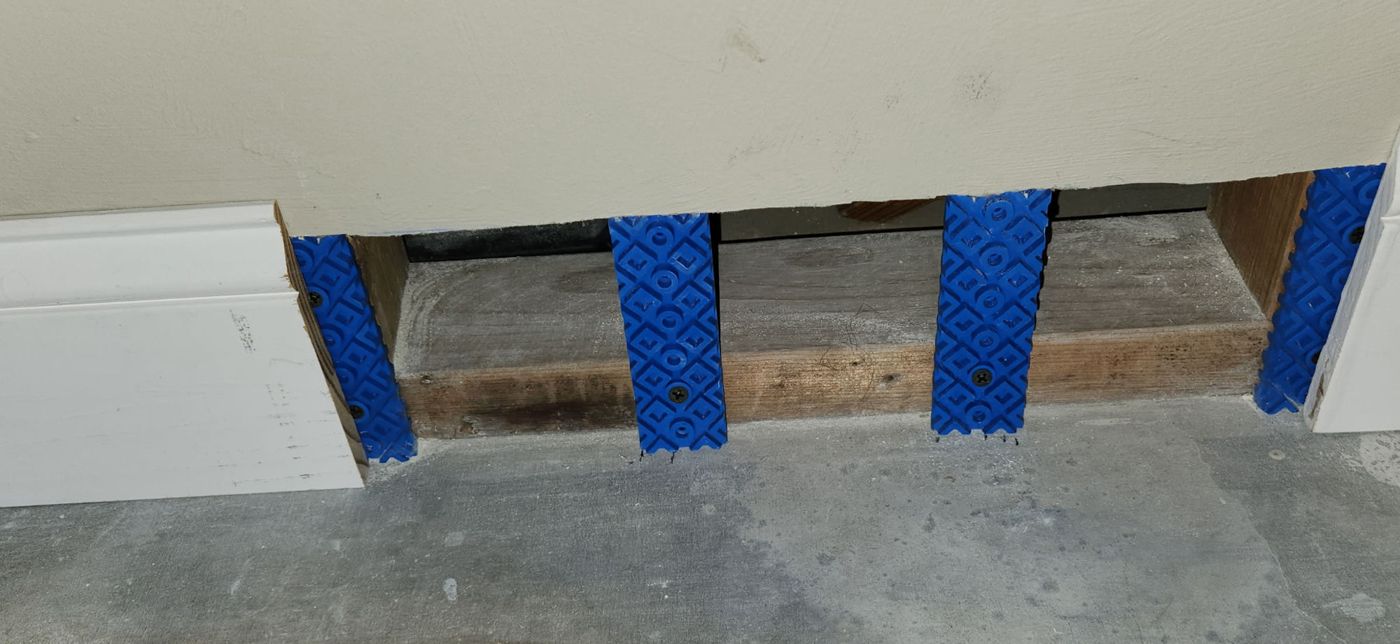
Rock Bloks is a patent-pending drywall drainage and ventilation system. The bloks mount at the base of each stud, and the drywall is hung resting on top of them rather than flush against the base plate. That leaves a continuous drainage and ventilation gap along the bottom of the wall, hidden behind the baseboard — so the cavity has a way to drain and breathe without anybody cutting it open first.
Want walls that give you the option?
Tell us about your home or project. The founder will personally reach out — how Rock Bloks installs, how many you would need, and whether it fits your build.
Get more information →Sources
- IICRC S500 Standard for Professional Water Damage Restoration — iicrc.org/s500
- U.S. EPA, Mold Course (Chapter 4) — epa.gov/mold
- Angi, Water Damage Restoration Cost [2026 Data] — angi.com
- FEMA, Dealing with Mold & Mildew in Your Flood-Damaged Home — fema.gov
Common questions
Do I always have to cut out wet drywall?+
No. Clean water, caught inside 24–48 hours, in a cavity that can actually be dried, and verified with a meter can often stay. Floodwater is the firm exception — it comes out.
Why do restoration crews cut two feet up by default?+
Because on most walls it is the only way to reach the cavity. The cut opens the bay so the framing, base plate, and insulation can be dried and cleaned. It also lands on a clean sheet dimension for the rebuild.
Can I dry a wall by drilling holes behind the baseboard?+
Sometimes, for clean-water events. Small holes low in each bay, covered on reinstall, give air a path into the cavity. It works when the water is clean and the volume is small; it does not fix contamination.
How do I know drying is working?+
Meter readings that fall day over day. If they plateau for two days, the cavity is not drying and the wall needs to be opened. See how long moisture stays in walls.
Does saving the drywall save much money?+
A lot. Drying runs roughly $3–$7.50 per square foot while repair and rebuild is more like $20–$37. The cost breakdown is here.