The short answer
Water damage restoration — the drying phase — typically runs $3 to $7.50 per square foot, with an average job around $3,900. Repair and rebuild after removal is a different number entirely: roughly $20 to $37 per square foot once drywall, insulation, flooring, and trim are replaced. FEMA estimates just one inch of flood water can cause about $25,000 of damage to an average home. The gap between drying a wall and rebuilding it is where the whole bill lives.
per sq ft — drying and restoration
per sq ft — repair and rebuild
FEMA estimate for one inch of flood water
The two bills
Every water event splits into two jobs that get priced very differently, and almost nobody knows which one they are getting until a week in.
| Line item | 2026 range | What it covers |
|---|---|---|
| Water damage restoration | $3 – $7.50 / sq ft | Extraction, air movers, dehumidification, monitoring, antimicrobial |
| Drywall replacement | $1.50 – $3 / sq ft | Removing and rehanging board, tape, mud, texture, paint |
| Full repair and rebuild | $20 – $37 / sq ft | Drywall, insulation, flooring, trim, and finishes together |
| Average restoration job | ~$3,900 ($1,400–$6,400+) | A typical single-event claim; multi-room floods run well past this |
Ranges reflect 2026 national cost data; regional labor and material pricing vary.
Look at the multiple. Rebuild costs roughly four to ten times what drying costs per square foot. Everything that determines your final number comes down to one question: how much of the wall had to come out?
What flood depth does to the number
FEMA’s flood cost estimates make the escalation concrete for an average home:
About $25,000 in damage. It only takes an inch to get into every wall in the house.
Around $52,000 for a typical 2,500 sq ft home.
Roughly $87,000 — and now flooring, cabinetry, and mechanicals are in play.
Notice how much damage one inch does. That is because an inch of water on the floor is not an inch of damage — it wicks up the paper facing of the drywall, gets into the cavity, and soaks the insulation and base plate. The visible waterline is the smallest part of it.
What actually drives the bill up
- →Water category. Floodwater is Category 3 under IICRC S500. Porous material that absorbed it is removed rather than dried — that decision alone moves you from the drying column to the rebuild column.
- →Time. Past the 24–48 hour window the EPA cites, mold remediation gets added to the scope, and clean water reclassifies to dirtier categories the longer it sits.
- →How much drywall comes out. A 2-foot flood cut around a 40-foot perimeter is 80 square feet of wall to rebuild. A 4-foot cut is 160.
- →Whether the cavity can dry. If it cannot, the cut is the only way to dry it — so demolition becomes mandatory rather than optional.
- →What is in the wall. Wet insulation is removed, not dried. Electrical and plumbing in the cut zone add trades.
Why the cavity decides everything
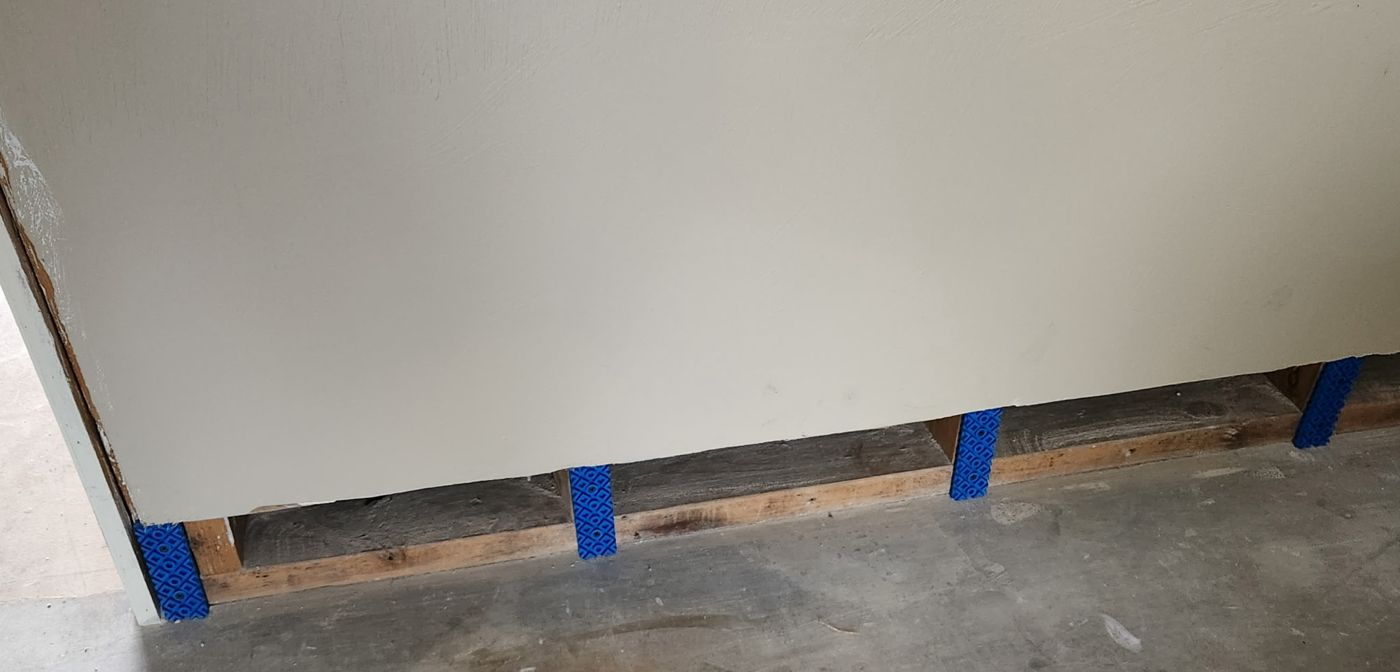
Here is the mechanism behind the whole cost structure. A standard wall runs drywall down flush to the base plate, so the cavity is sealed at the bottom. When water gets in, it pools there — no drainage, no airflow, nothing to carry the moisture out. There is no way to dry that pocket without opening the wall.
So the flood cut is not a preference. It is the only tool available, and it is what converts a $3–$7.50 per square foot drying job into a $20–$37 per square foot rebuild.
Sealed wall — the expensive path
- ✕ Cavity cannot drain or ventilate
- ✕ Drying alone will not reach the trapped water
- ✕ Flood cut becomes mandatory
- ✕ Drywall, insulation, trim, and paint all rebuilt
Draining wall — the cheaper path
- ✓ Water leaves at the base under gravity
- ✓ Air reaches the cavity to dry it
- ✓ Less material has to come out to dry it
- ✓ Less demolition means less rebuild
Rock Bloks is a patent-pending drywall drainage and ventilation system. The bloks mount at the base of each stud and hold the drywall off the base plate, leaving a continuous gap along the bottom of the wall behind the baseboard. Water drains back out through that gap and air flows up into the cavity — so the wall has a chance to dry inside the window that matters, instead of only being dryable after somebody cuts it open.
What the numbers show is which line item is worth attacking. It is not the drying. It is the demolition.
Building or rebuilding? Ask about the wall detail.
Tell us about your home or project. The founder will personally reach out — how Rock Bloks installs, how many you would need, and whether it fits what you are doing.
Get more information →Sources
- Angi, Water Damage Restoration Cost [2026 Data] — angi.com
- HomeGuide, Water Damage Restoration Cost (2026) — homeguide.com
- FEMA, Flood Insurance & flood cost estimates — fema.gov
- IICRC S500 Standard for Professional Water Damage Restoration — iicrc.org/s500
- U.S. EPA, Mold Course (Chapter 4) — epa.gov/mold
Common questions
How much does water damage restoration cost?+
Roughly $3 to $7.50 per square foot for the drying phase, with a typical job landing near $3,900 and a common range of about $1,400 to $6,400. Multi-room flood jobs go well beyond that.
How much does it cost to replace water-damaged drywall?+
Drywall replacement alone runs about $1.50 to $3 per square foot. Once flooring, insulation, and trim are included, full repair and rebuild is more like $20 to $37 per square foot.
How much damage does one inch of flood water do?+
FEMA estimates about $25,000 for an average home. Six inches runs around $52,000 for a 2,500 sq ft house, and two feet approaches $87,000.
Does homeowners insurance cover this?+
Generally, sudden internal water damage (a burst pipe) may be covered while flooding from outside is not — that requires separate flood insurance through the NFIP or a private carrier. Policies vary, so read yours before you need it.
What is the cheapest way to handle a flooded wall?+
Cutting the drying time down. Every extra day wet moves the job from drying toward removal, and removal is where the cost multiplies. See when you do not have to tear out wet drywall.