The short answer
FEMA classifies building materials 1 through 5, and only Class 4 and Class 5 are acceptable below the Base Flood Elevation. In practice that means concrete and masonry, closed-cell foam insulation, pressure-treated or naturally decay-resistant lumber, ceramic tile with the right setting materials, and non-paper-faced gypsum board — not standard paper-faced drywall, not fiberglass batt, not particleboard. But material class alone does not dry a wall: the assembly still has to let water out and air in.
the only acceptable classes below the BFE
two opposite floodproofing strategies
the two FEMA bulletins that govern this
First, pick your strategy
Before materials, FEMA distinguishes two fundamentally different approaches, and they lead to opposite decisions.
Dry floodproofing
- ✕ Make the building watertight and substantially impermeable
- ✕ Structure must resist the flood loads pushing on it
- ✕ Sealants, shields, membranes, closures
- ✕ In NFIP regulations, "floodproofing" generally means this
Wet floodproofing
- ✓ Let water enter and exit the structure automatically
- ✓ Equalizes pressure instead of resisting it
- ✓ Flood damage-resistant materials throughout
- ✓ Covered by FEMA Technical Bulletin 7
Dry floodproofing keeps water out — and when it is overtopped or breached, the water that got in has no way back out. Wet floodproofing accepts that water will get in and designs for it. For enclosures below the Base Flood Elevation in residential construction, wet floodproofing with flood damage-resistant materials is generally the path, and that is what Technical Bulletin 7 covers.
The material classes
Technical Bulletin 2 sets the rule that matters: a flood damage-resistant material can be wetted and dried without requiring significant repair. Classes 1–3 are unacceptable below the BFE; Classes 4 and 5 are acceptable.
| Component | Works below the BFE | Does not |
|---|---|---|
| Wall structure | Concrete, concrete block, brick, pressure-treated or naturally decay-resistant lumber | Untreated dimensional lumber in contact with flood water |
| Wall board | Non-paper-faced / fiberglass-faced gypsum, cement board | Standard paper-faced drywall — it wicks and feeds mold |
| Insulation | Closed-cell rigid foam, spray polyurethane | Fiberglass batt, cellulose, mineral wool batt — they hold water |
| Finishes | Ceramic or stone tile with flood-resistant setting materials, latex or epoxy paint | Carpet and pad, laminate, particleboard, MDF trim |
| Fasteners & trim | Hot-dipped galvanized or stainless, PVC or composite trim | Plain steel fasteners, paper-faced trim |
General guidance. Your community sets the floodplain requirements that actually apply — confirm with your building department.
The detail the material lists leave out
Read TB-2 closely and the standard is telling: a material qualifies if it can be wetted and dried without significant repair. Wetted and dried.
Material class governs what the wall is made of. It says nothing about whether the wall can actually dry. And in a conventional assembly it usually cannot — because the drywall runs down flush to the base plate and the cavity is sealed at the bottom. Build that same wall out of perfect Class 5 materials and you still get water pooled in a closed bay with no drainage and no airflow. The framing stays wet, the trapped water re-wets everything above it, and you are still opening the wall to dry it out.
The two questions to ask about any flood-resilient wall
1. Can these materials survive being wet? That is the material class question, and TB-2 answers it. 2. Can this assembly get rid of the water and dry itself out? That is the drainage and ventilation question — and the material list does not answer it at all.
Closing the second half
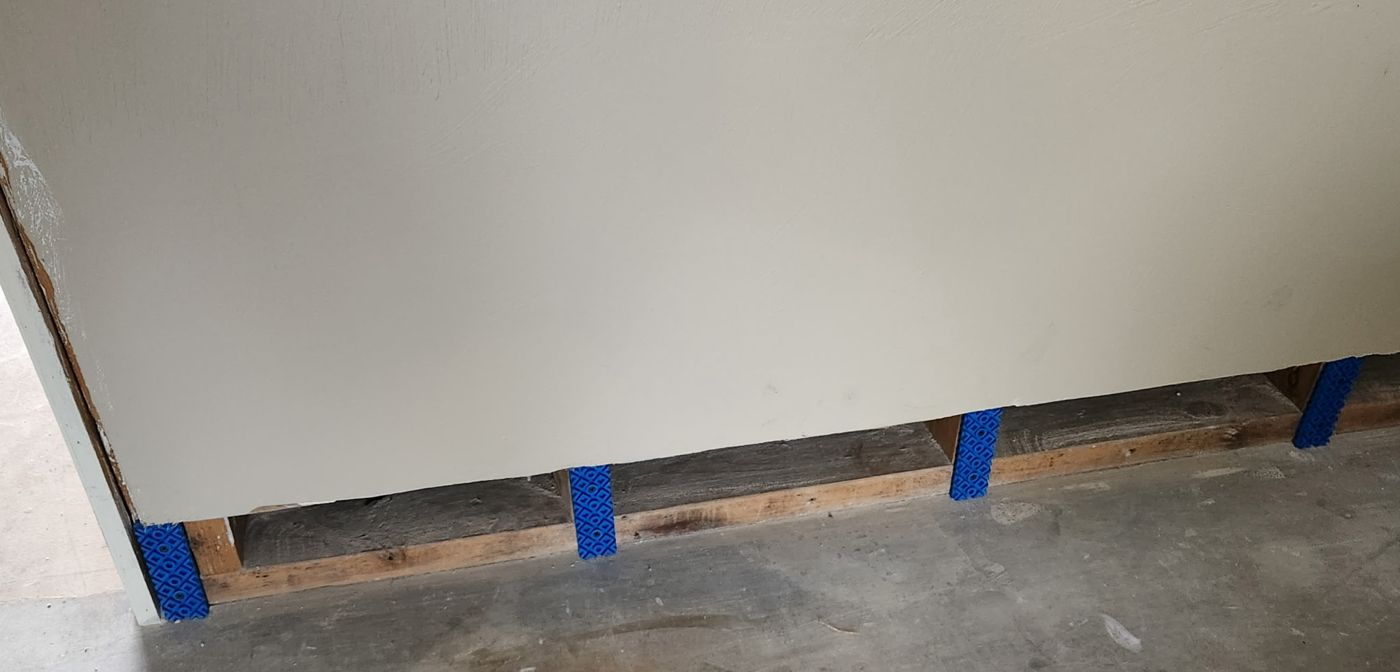
Rock Bloks is a patent-pending drywall drainage and ventilation system that addresses the second question. Rigid perforated polymer bloks mount at the base of each stud and hold the drywall off the base plate, leaving a continuous gap along the bottom of the wall — hidden behind the baseboard. Water that gets into the cavity drains back out under gravity, and air flows up into the bay so the assembly dries rather than holding moisture against the framing.
It is the same principle wet floodproofing is built on, applied at the wall: let the water in if it is coming, and give it a way back out.
Specifying a wall below the flood elevation?
Tell us about your project. The founder will personally reach out — how Rock Bloks installs, how many you would need, and whether it fits your assembly.
Get more information →Sources
- FEMA NFIP Technical Bulletin 2, Flood Damage-Resistant Materials Requirements — fema.gov
- FEMA NFIP Technical Bulletin 7, Wet Floodproofing Requirements and Limitations — fema.gov
- FEMA, National Flood Insurance Technical Bulletins — fema.gov
- U.S. EPA, Mold Course (Chapter 4) — epa.gov/mold
Common questions
What materials does FEMA allow below the Base Flood Elevation?+
Only Class 4 and Class 5 materials — ones that can be wetted and dried without requiring significant repair. In practice: concrete and masonry, closed-cell foam, pressure-treated or decay-resistant lumber, tile with flood-resistant setting materials, and non-paper-faced gypsum board.
Is regular drywall allowed below the BFE?+
Standard paper-faced gypsum board is not appropriate below the BFE — the paper facing wicks water above the flood line and feeds mold. Non-paper-faced gypsum board is accepted in FEMA guidance.
What is the difference between wet and dry floodproofing?+
Dry floodproofing makes a building watertight and substantially impermeable so water stays out, and the structure must resist the flood loads. Wet floodproofing lets water enter and exit automatically, using flood damage-resistant materials to limit the damage.
Does closed-cell foam insulation really survive flooding?+
Closed-cell rigid foam and spray polyurethane are the insulation types FEMA guidance points to below the BFE, because they do not absorb and hold water the way batt insulation does. Fiberglass and cellulose that have been flooded are removed.
Do flood-resistant materials mean I will not have to gut the wall?+
They reduce what has to be replaced, but they do not by themselves let the wall dry. If the cavity is still sealed at the base with no drainage or airflow, it still has to be opened to dry out. See what a drywall ventilation system is.