The short version
Below the Base Flood Elevation, FEMA's National Flood Insurance Program requires flood damage-resistant materials — standard paper-faced drywall and fiberglass batt don't qualify. But here's the gap the rules leave open: even an "approved" material has to dry out after it gets wet. A wall that traps water at the base stays wet no matter what it's made of.
Start with your flood zone and your BFE
If your lot sits in a FEMA Special Flood Hazard Area (zones beginning with A or V on the flood map), construction below the Base Flood Elevation (BFE) is governed by NFIP rules and your local floodplain ordinance. The BFE is the height water is expected to reach in a "base flood" — the flood with a 1% chance of occurring in any given year, often called the 100-year flood. Anything built below that line has to be able to take a soaking.
What FEMA does and doesn't allow below the line
FEMA's Technical Bulletin 2 classifies common building materials as acceptable or unacceptable for use below the BFE. The dividing line is simple: can the material be wetted and dried without losing its structure or harboring contamination? Here's how the common wall materials sort out.
Not acceptable below BFE
- ✕ Standard paper-faced gypsum drywall
- ✕ Fiberglass batt insulation
- ✕ Particleboard / non-treated MDF
- ✕ Standard carpet & pad
Acceptable below BFE
- ✓ Non-paper-faced gypsum board
- ✓ Closed-cell foam insulation
- ✓ Pressure-treated / decay-resistant lumber
- ✓ Concrete, masonry, ceramic tile
FEMA is careful to add that flood damage-resistance also depends on the application and on what's in the local floodwater — sound judgment still matters. Always confirm the current list and your local ordinance with your floodplain administrator before you spec a wall.
The gap the materials list leaves open
Here's what Technical Bulletin 2 controls — and what it doesn't. It tells you the wall should be built from things that can survive getting wet. It doesn't make the wall actually dry. And that's the part that determines whether a flood-zone wall comes through a storm or comes out in a dumpster.
Picture the approved wall after a flood: non-paper-faced board, closed-cell foam, treated plate. All "resistant." But it's still built the standard way — drywall sealed down against the base plate, cavity closed at the bottom. Water gets in, runs to the base, and sits. The materials don't dissolve, but the trapped water has no exit and no airflow, so the cavity stays damp for weeks. Damp wood frames, fasteners, and any organic dust become a mold substrate. You met code and still lost the wall to moisture that couldn't leave.
Flood-resistant materials, standard build
- ✕ Cavity sealed at the base
- ✕ Water collects against the base plate
- ✕ No airflow to carry moisture out
- ✕ Stays damp; mold risk despite "resistant" materials
Flood-resistant materials + Rock Bloks
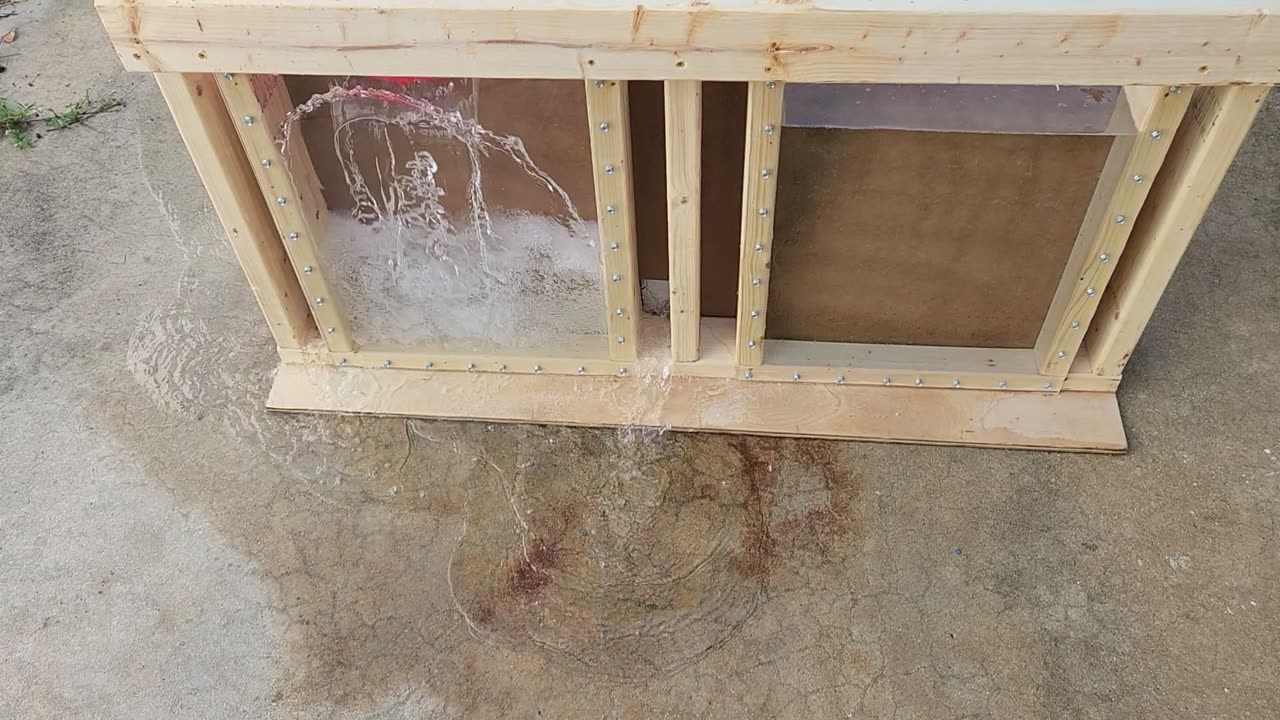
- ✓ Continuous gap at the base — water drains out
- ✓ Air flows up into the cavity
- ✓ Wall dries in days, not weeks
- ✓ Resistant materials get the chance to actually recover
Build it to drain, not just to resist
Water-resilient construction is two jobs, not one: pick materials that can survive a soaking, and build the wall so it can let the water back out. The materials list handles the first. Rock Bloks handles the second.
Rock Bloks is a patent-pending drywall drainage and ventilation system. The bloks mount at the base of each stud during framing and lift the drywall off the base plate, leaving a continuous gap along the bottom of the wall. Water drains out through that gap instead of pooling, and air flows up into the cavity instead of being sealed in. Spec it from the framing stage and your flood-zone wall doesn't just resist water — it gets rid of it. Same studs, same base plate, standard framing, roughly one blok per stud.
Speccing a flood-zone build?
Tell us about the project. The founder will personally reach out — how Rock Bloks fits your wall assembly, how many you'd need, and pricing for the job.
Get more information →Sources
- FEMA, Technical Bulletin 2 — Flood Damage-Resistant Materials Requirements — fema.gov
- FEMA, National Flood Insurance Technical Bulletins — fema.gov
- U.S. EPA, Mold Course (24–48 hr window) — epa.gov/mold