The short answer
Wet drywall can often be saved if the water was clean, it has been wet for less than 24–48 hours, and it can be dried from both sides. It has to come out if the water was contaminated (any floodwater), if it is sagging or crumbling, or if it stays above roughly 17% moisture after drying. The deciding factor is almost never the surface — it is whether the cavity behind it can drain and breathe.
the window to dry wet material before mold starts
moisture reading above which drywall usually has to be replaced
how the restoration standard classes any floodwater
First: how dirty was the water?
Before anything else, the restoration standard (IICRC S500) sorts water into three categories, and the category — not the amount — decides whether drywall can be dried in place or has to be removed.
| Category | What it is | What happens to the drywall |
|---|---|---|
| Category 1 | Clean water — a supply line, a water heater, rain that has not touched the ground | Often dryable in place if you catch it fast |
| Category 2 | Grey water — appliance discharge, an overflow with some contamination | Sometimes dryable; may be removed depending on time and materials |
| Category 3 | Black water — sewage, ground surface water, and all floodwater | Porous material is removed, not dried |
Category also degrades with time: clean water left sitting becomes Category 2, then 3.
That last row is the one most homeowners get wrong. If a storm or a rising creek put the water in your house, it is Category 3 — and porous materials that soaked it up come out regardless of how good they look. Drying a Category 3 wall is not a shortcut; it leaves contamination inside the cavity.
Second: how long has it been wet?
The EPA is direct about this — mold generally will not grow if wet materials are dried within 24–48 hours. That is the clock that matters, and it starts when the water arrives, not when you notice.
Clean water, dried aggressively from both sides. Best odds the drywall survives.
The window is closing. Growth may already be underway inside the cavity.
Assume the cavity is colonized. Removal becomes the realistic call.
Third: what does the meter say?
Feel is not evidence. Drywall dries from the outside in, so the face can feel completely dry while the core and the framing behind it are still soaked. A pin or pinless moisture meter is the only honest read:
- →Under 1% — genuinely dry drywall.
- →5–12% — generally considered a safe, normal range.
- →Above ~17% — compromised. This drywall usually has to be replaced.
- →The comparison test: restoration crews dry back to within roughly 10% of undamaged drywall elsewhere in the same house.
Take readings low on the wall, at the base, not at eye level. Water goes down. The bottom 6–12 inches tell you what is really happening.
The flood cut — and why it exists
When drywall has to come out after flooding, crews rarely take the whole wall. They cut a horizontal line above the waterline — commonly at 2 feet or 4 feet, because those are clean sheet dimensions — and remove everything below it. That opens the cavity so the framing, the insulation, and the base plate can actually dry and be cleaned.
Notice what the flood cut is really doing: it is manufacturing the drainage and airflow the wall never had. Somebody has to demolish part of the wall to give the cavity a way out.
What actually keeps a wall wet
In a standard wall, drywall runs down flush to the base plate and the floor. The cavity behind it is sealed at the bottom. When water gets in, gravity pulls it to that sealed corner — where it cannot drain out and no air can reach it. You can run fans on the room side for a week and the pocket at the base stays wet, quietly re-wetting the material above it.
That is the reason so many walls that "dried" get torn out anyway a month later.
Standard wall
- ✕ Sealed at the base — water pools with no exit
- ✕ Cavity cannot ventilate
- ✕ Surface reads dry while the core stays wet
- ✕ Flood cut and tear-out to open it up
Wall built with Rock Bloks
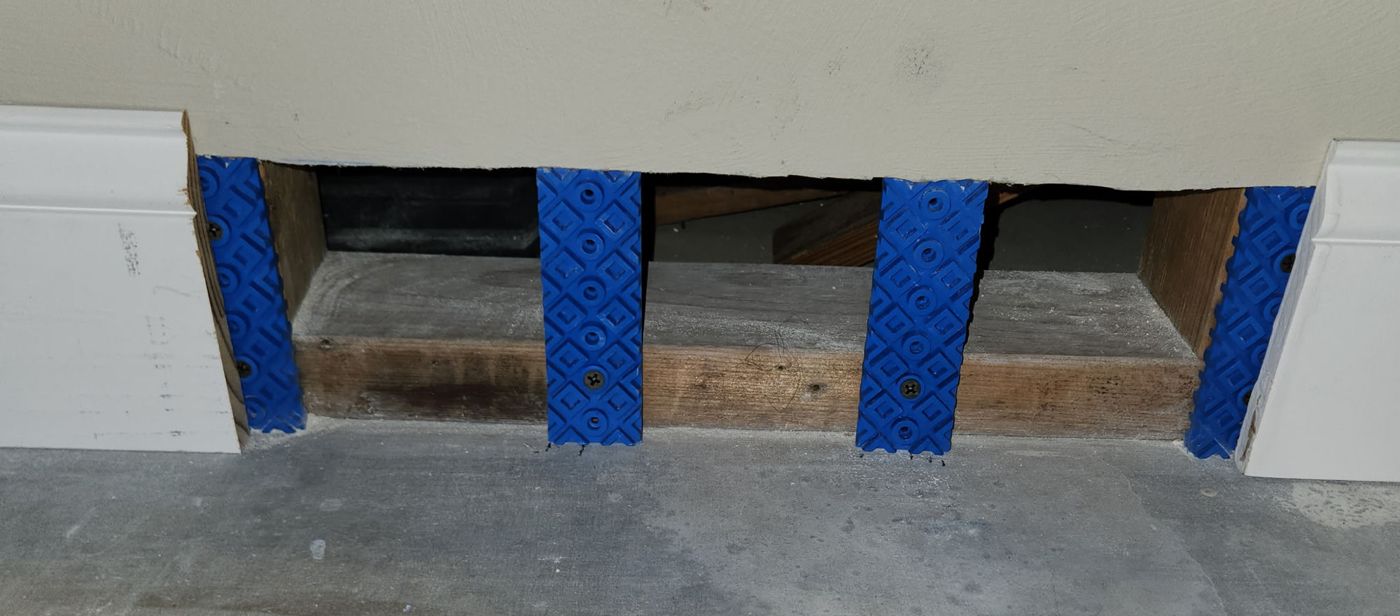
- ✓ Continuous gap at the base — water drains out
- ✓ Air flows up into the cavity
- ✓ The cavity dries, not just the face
- ✓ Far less demolition
The structural fix
Rock Bloks is a patent-pending drywall drainage and ventilation system. The bloks mount at the base of each stud and hold the drywall up off the base plate, leaving a continuous gap along the bottom of the wall — hidden behind the baseboard. Water that gets into the cavity drains back out through that gap instead of pooling, and air flows up into the cavity instead of being sealed out. Same studs, same base plate, standard framing.
Rebuilding a wall that just got soaked?
Tell us about your home or project. The founder will personally reach out — how many you would need, how it installs, and whether Rock Bloks is the right call.
Get more information →Sources
- IICRC S500 Standard for Professional Water Damage Restoration — iicrc.org/s500
- U.S. EPA, Mold Course (Chapter 4) — epa.gov/mold
- FEMA, Dealing with Mold & Mildew in Your Flood-Damaged Home — fema.gov
Common questions
Does wet drywall always have to be replaced?+
No. Clean water caught inside 24–48 hours and dried from both sides can often be saved. Floodwater is a different story — the restoration standard classes it as Category 3, and porous materials that absorbed it are removed rather than dried.
How can I tell if drywall is dry behind the paint?+
Use a moisture meter low on the wall, not your hand. Drywall dries face-first, so the surface can read dry while the core and the framing are still wet. Under 1% is dry; above roughly 17% means it needs to come out. See how long drywall takes to dry.
Can I just cut out the bottom two feet?+
That is the standard flood cut, and it works — because it opens the cavity so the framing and base plate can dry and be cleaned. It is demolition doing the job that drainage and ventilation would have done on their own.
Will a dehumidifier dry the inside of the wall?+
It dries the room and the drywall face. It only dries the cavity if the cavity has an opening for air to move through. In a wall sealed at the base, the trapped pocket at the bottom stays wet — which is why walls stay wet for months.
How long before mold starts on wet drywall?+
Spores can begin germinating within 24–48 hours, and colonies often become visible at 48–72 hours. Warm, humid, still air speeds it up. Paper-faced drywall is a food source, which is why it colonizes so readily.