The short answer
In a wall cavity that cannot drain or ventilate, trapped moisture commonly lasts several weeks to a few months. The drywall face dries in days and feels finished, while water sitting at the sealed base of the cavity has no exit and no airflow. Moisture only leaves quickly when the cavity can do two things at once: drain water out and pull dry air through.
how long a sealed cavity can hold moisture
how long the drywall surface takes to dry
indoor relative humidity the EPA suggests keeping below
Why the surface lies to you
Drying happens at surfaces. Air moves across the face of the drywall, picks up moisture, and carries it away — so the face is always the first thing to dry and the first thing to feel normal. The inside of the cavity has no air moving across it at all.
So the timeline splits in two. With air movers and an LGR dehumidifier running, the drywall surface dries in roughly 3–5 days. The cavity behind it — the framing, the insulation, the base plate, and whatever water pooled at the bottom — is on its own schedule, and that schedule is measured in weeks.
What decides whether it is weeks or months
- →Whether the water can drain. Standing water at the base of a cavity keeps re-wetting the material above it. Nothing dries above a puddle.
- →Whether air can get in. No airflow, no drying. A sealed cavity is a closed box.
- →Insulation. Wet fiberglass or cellulose holds water against the framing and blocks what little air movement there might be.
- →Ambient humidity. The EPA recommends keeping indoor relative humidity below about 60%, ideally 30–50%. Humid air will not pull moisture out of anything.
- →Temperature. Warm, still, humid air is the worst case — it holds moisture in place and accelerates growth at the same time.
How to tell if your wall is still wet
You cannot do this by feel, and you cannot do it by looking at paint. Four things that actually work:
- Moisture meter, low on the wall. Read the bottom 6–12 inches. Compare against a wall in the same house that never got wet — the difference is the answer.
- Pull a baseboard. The base of the cavity is where water collects. It is also where staining, swelling, and growth show first.
- Smell at the outlet. Kill the breaker, pull an outlet cover on the affected wall, and smell. A musty smell from inside a wall is not ambiguous.
- Watch the trim and paint. Baseboard that keeps cupping, tape joints that keep cracking low on the wall, or paint that bubbles months after the event mean moisture never left.
Surface dries. Room feels normal. Cavity is still holding water at the base.
Framing and base plate stay damp. Musty odor develops. Growth is underway out of sight.
Staining bleeds through, trim moves, joints crack. Now it is a demolition job.
The reason it does not leave
A standard wall is built as a closed cavity: drywall runs down flush against the base plate, the baseboard seals over the joint, and the bottom of the bay has no opening. That is fine on a dry day. The moment water gets in, the same detail that keeps drafts out keeps the water in — and keeps air from ever reaching it.
This is why the standard remedy is demolition. A flood cut does not add any drying capability the wall did not have; it simply removes the part of the wall that was sealing the cavity shut.
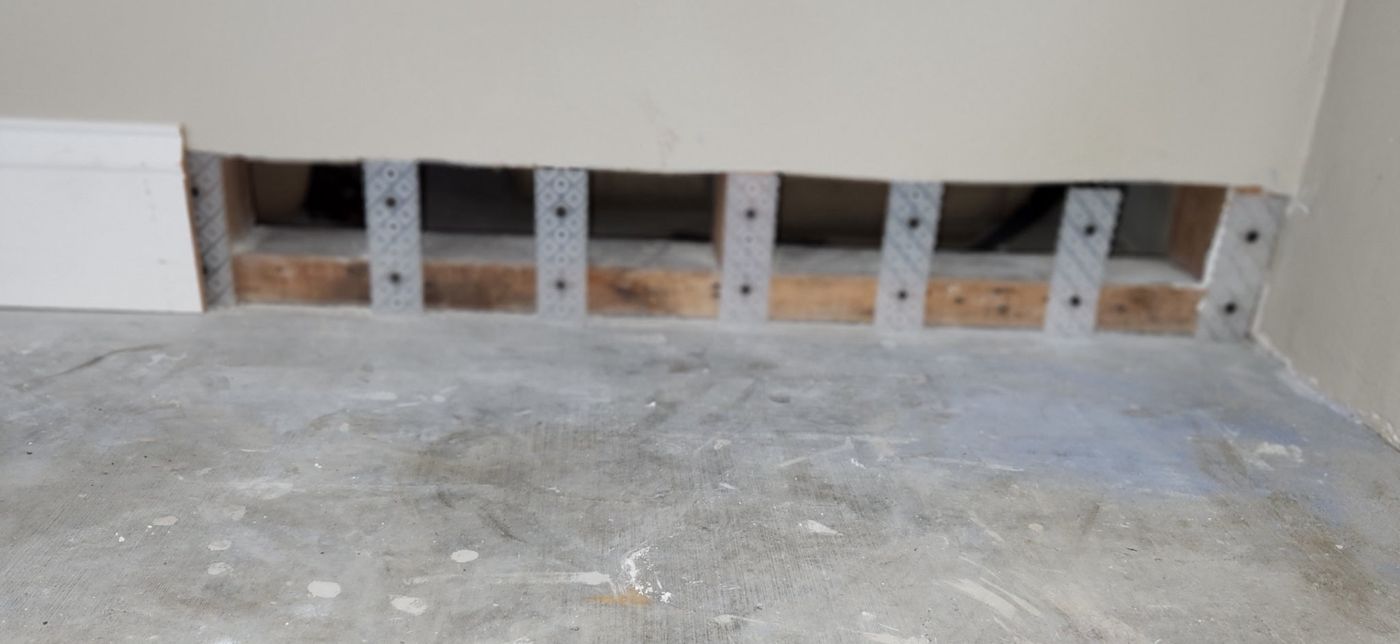
Building the exit in from the start
Rock Bloks mounts at the base of each stud and holds the drywall up off the base plate, leaving a continuous gap along the bottom of the wall behind the baseboard. Water in the cavity drains out through that gap under gravity, and air flows up into the bay in the reverse direction. The cavity dries on the same timeline as the room instead of on its own hidden one.
Sealed cavity
- ✕ Water pools at the base plate with no exit
- ✕ No air path — the bay is a closed box
- ✕ Meter still reads wet weeks later
- ✕ Fixed by cutting the wall open
Cavity with Rock Bloks
- ✓ Water drains out at the base under gravity
- ✓ Air flows up into the bay continuously
- ✓ Cavity dries with the room, not months behind it
- ✓ Nothing to cut open
Tired of guessing whether the wall is dry?
Tell us about your home or project. The founder will personally reach out — how Rock Bloks installs, how many you would need, and whether it fits what you are building.
Get more information →Sources
- IICRC S500 Standard for Professional Water Damage Restoration — iicrc.org/s500
- U.S. EPA, Mold Course (Chapter 4) — epa.gov/mold
- U.S. EPA, A Brief Guide to Mold, Moisture and Your Home — epa.gov
Common questions
How long can moisture stay trapped in a wall?+
In a sealed cavity that cannot drain or breathe, several weeks to a few months is normal. The surface dries in days and feels finished the whole time.
Can a wall dry on its own without opening it up?+
Only if the cavity has an air path. If the bay is sealed at the base plate — the way nearly every wall is built — there is no route in for dry air and no route out for the water, so it sits.
Is it bad if drywall is still damp after a month?+
Yes. A month of dampness is well past the 24–48 hour window the EPA cites for preventing mold growth, so assume there is growth in the cavity. It is a signal to open the wall, not to wait longer.
Does insulation make it worse?+
It does. Wet fiberglass or cellulose holds water against the framing and blocks the little airflow that might otherwise exist. Wet insulation in a flooded bay is normally removed, not dried.
What humidity should I keep the room at while drying?+
The EPA suggests keeping indoor relative humidity below about 60%, and ideally in the 30–50% range. Humid room air will not pull moisture out of a wall — see how to dry out walls after a flood.