The short answer
The most reliable sign of mold inside a wall is a persistent musty odor with no visible source, usually paired with a history of water — a leak, a flood, or a wall that stayed damp. Staining, bubbling paint, and warped baseboard are the visible confirmations. The EPA's position is that sampling is generally not necessary: if you can see or smell mold, the answer is to find the moisture and fix it, not to test it.
from wet material to the start of growth
EPA threshold above which professional remediation is suggested
the one thing every remediation has to fix to be permanent
The signs, in the order they usually show up
A musty, earthy odor that is stronger near one wall, near the floor, or when the HVAC runs. Often the only early sign.
Staining or dark spotting bleeding through paint, usually low on the wall. Paint that bubbles, peels, or blisters.
Baseboard cupping or pulling away, tape joints cracking near the floor, drywall soft or crumbling at the base.
The symptom question
People often notice how they feel before they notice the wall. According to the CDC, exposure to damp and moldy environments can cause symptoms including a stuffy nose, sore throat, coughing, wheezing, and eye or skin irritation, with stronger reactions for people who have asthma or a mold allergy. A useful pattern to watch for: symptoms that ease when you leave the house and return when you come back.
That is a signal to go looking for moisture — not a diagnosis. Health questions go to a physician; the wall question is the one you can answer yourself.
How to actually check a wall
- Start with the water history. Mold does not appear without moisture. A past leak, a flood, a slab issue, a bathroom on the other side of that wall — that is where to look first.
- Take moisture readings low on the wall. Use a meter on the bottom 6–12 inches and compare it to a wall in the same house that never got wet.
- Pull a section of baseboard. This is the highest-yield check in the house. The base of the cavity is where water collects and where growth starts, and baseboard comes off without real damage.
- Smell at an outlet. Kill the breaker first, then pull the cover plate. You are sampling air straight out of the cavity.
- Look behind, not at. Under sinks, behind appliances, at the bottom of exterior walls, and anywhere the floor covering has cupped.
What the EPA says about testing
The EPA states that in most cases sampling for mold is not necessary. If mold is visible or you can smell it, remediation is the answer regardless of what species it is — and there are no federal standards for acceptable airborne mold levels to test against. Spend the money on finding and fixing the moisture, not on identifying the organism.
How big is too big to handle yourself
The EPA’s widely used rule of thumb is 10 square feet — roughly a 3 ft × 3 ft patch. Below that, a careful homeowner can generally handle cleanup. Above it, or if the water was sewage or floodwater, or if anyone in the house is immune-compromised or asthmatic, bring in a remediation professional.
One caution specific to walls: what you can see on the room side is the small end of it. A visible spot at the baseboard usually means the bay behind it has been damp for a while.
Why walls are where it happens
A wall cavity is close to a perfect incubator. Paper-faced drywall is a food source. The bay is dark and still. And because a standard wall is sealed at the base plate, water that gets in cannot drain out and no dry air can get in — so the one condition mold needs, sustained moisture, is exactly the condition the wall is built to preserve.
Standard wall cavity
- ✕ Sealed at the base — water has no exit
- ✕ No airflow through the bay
- ✕ Paper facing feeds growth
- ✕ Stays damp long past the 24–48 hour window
Cavity with Rock Bloks
- ✓ Water drains out at the base plate line
- ✓ Air moves up through the bay
- ✓ Dries inside the window that matters
- ✓ Removes the condition, not just the colony
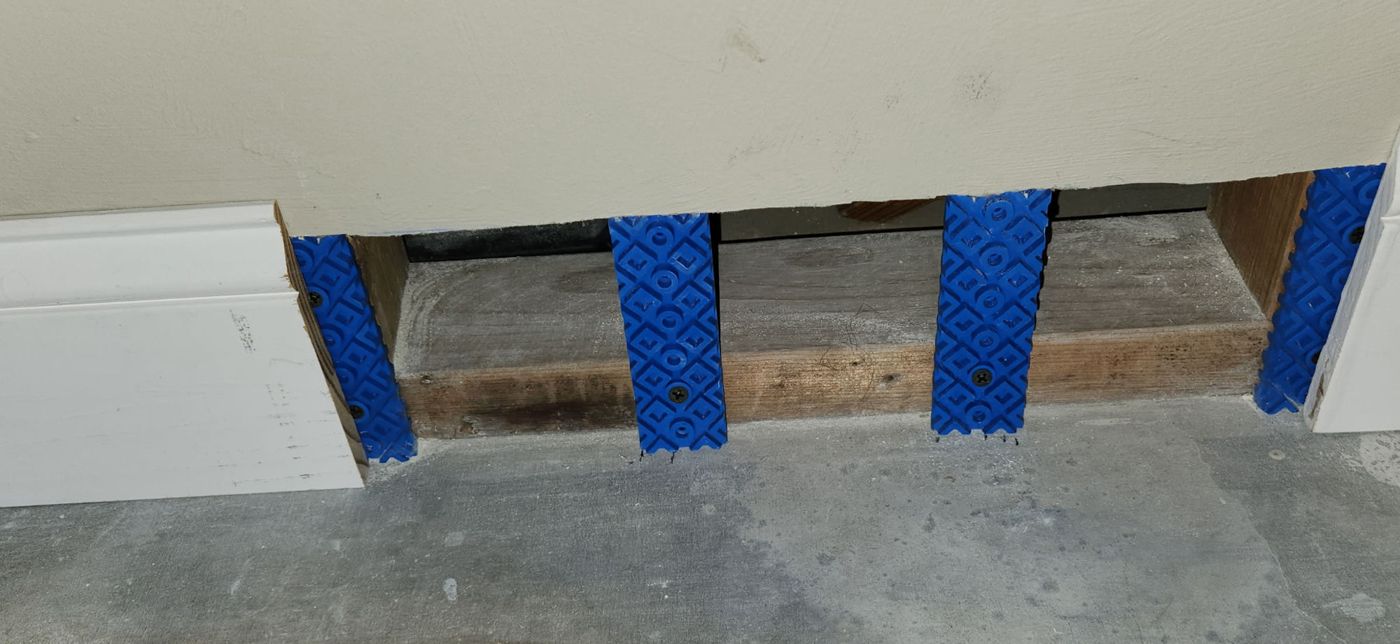
Rock Bloks is a patent-pending drywall drainage and ventilation system. The bloks mount at the base of each stud and hold the drywall off the base plate, leaving a continuous drainage and ventilation gap along the bottom of the wall, hidden behind the baseboard. Remediation removes the mold; drainage and ventilation remove the reason it was there.
Want a wall that cannot stay wet?
Tell us about your home or project. The founder will personally reach out — how Rock Bloks installs, how many you would need, and whether it fits your build.
Get more information →Sources
- U.S. EPA, A Brief Guide to Mold, Moisture and Your Home — epa.gov
- U.S. EPA, Mold Remediation in Schools and Commercial Buildings — epa.gov
- CDC, Mold and Your Health — cdc.gov
- U.S. EPA, Mold Course (Chapter 4) — epa.gov/mold
Common questions
What does mold inside a wall smell like?+
Musty and earthy, like a damp basement or old cardboard. It usually gets stronger near the floor, near one specific wall, or when the HVAC runs and pulls air through the cavity.
Should I have my walls tested for mold?+
The EPA says sampling is generally not necessary. If you can see or smell mold, the response is the same regardless of species: find the moisture source, fix it, and remove the affected material.
Can mold grow in a wall with no visible water damage?+
Yes. It only takes sustained moisture — a slow supply-line drip, condensation on a cold line, or a flood that was "dried" on the surface while the cavity stayed wet. The room side can look untouched.
How much wall mold can I clean myself?+
The EPA uses about 10 square feet as the rough dividing line. Above that, or with sewage or floodwater involved, or with anyone in the house asthmatic or immune-compromised, use a remediation professional.
Will killing the mold stop it coming back?+
Not on its own. Mold returns wherever the moisture returns. Permanent fixes address the water: stop the source, and give the cavity a way to drain and breathe. See how to prevent mold inside your walls.