The short answer
A wet drywall ceiling that is sagging, bulging, or dripping is a safety issue first — stay out from under it, kill the power to that area, and relieve the water with a small drain hole from the side rather than waiting. Once it is safe, ceilings that were wet from clean water and dried within 24–48 hours can sometimes be saved; sagging, crumbling, or floodwater-soaked ceilings come out. Then check the walls — water that ran through a ceiling almost always ran down inside them.
the window before mold begins
from under any bulging or sagging section
the ceiling is rarely where the water stopped
Safety, in order
- Get out from under it. Wet drywall is heavy, and a saturated section can come down all at once. Move furniture out and keep people and pets clear of the whole area, not just the visible stain.
- Kill the power to that area at the breaker. Ceilings hold light fixtures and junction boxes. Do not operate a switch in a room with water coming through the ceiling.
- Relieve the water deliberately. A bulge is a pocket of water pushing on a sheet. From the side — not underneath — put a small hole at the low point with a screwdriver and let it drain into a bucket. A controlled hole is far better than an uncontrolled collapse.
- Find and stop the source. A supply line, a drain, an HVAC condensate pan, an upstairs fixture, or the roof. Drying anything while water is still arriving is wasted effort.
Can the ceiling be saved?
Same test as any other drywall, with gravity making it stricter. Under the restoration standard (IICRC S500), the question is how clean the water was and how long the material stayed wet.
| Situation | Realistic call |
|---|---|
| Small clean-water stain, caught fast, no sag | Dry it, monitor with a meter, repaint once genuinely dry |
| Visible sag, bulge, or soft spots | Remove it — the gypsum core has lost strength and will not come back |
| Textured or popcorn ceiling in a pre-1980s home | Stop. Assume asbestos until tested; do not sand, scrape, or break it up |
| Wet more than 48 hours, or any floodwater | Remove — assume growth in the cavity above |
Then check the insulation above it
Ceiling drywall is usually the bottom of an insulated cavity. Wet insulation sitting on the back of that sheet keeps re-wetting it, adds weight, and blocks any drying. If the ceiling got soaked, the insulation above almost always comes out too — it is the single most-skipped step in a DIY ceiling repair.
The part people miss: where the water went next
Water that comes through a ceiling did not start there. It travelled — along joists, down the top plate, and into the wall cavities. What you see on the ceiling is the low point where it finally broke through, and it is often nowhere near where it entered.
Which means the ceiling is the visible half of the job. The walls below and around it are the invisible half, and they behave differently: a wall cavity is sealed at the base plate, so anything that ran down inside it collects at the bottom where it cannot drain out and no air can reach it. The ceiling dries because it is open on top. The wall does not.
- →Take moisture readings on the bottom 6–12 inches of every wall near the leak, not at eye level.
- →Pull a section of baseboard on the wall directly below the ceiling stain.
- →Watch for baseboard cupping or paint blistering low on the wall in the weeks after — that is trapped water, not a paint defect.
- →A musty smell that outlasts the ceiling repair means the cavity never dried.
Fixing the wall side for good
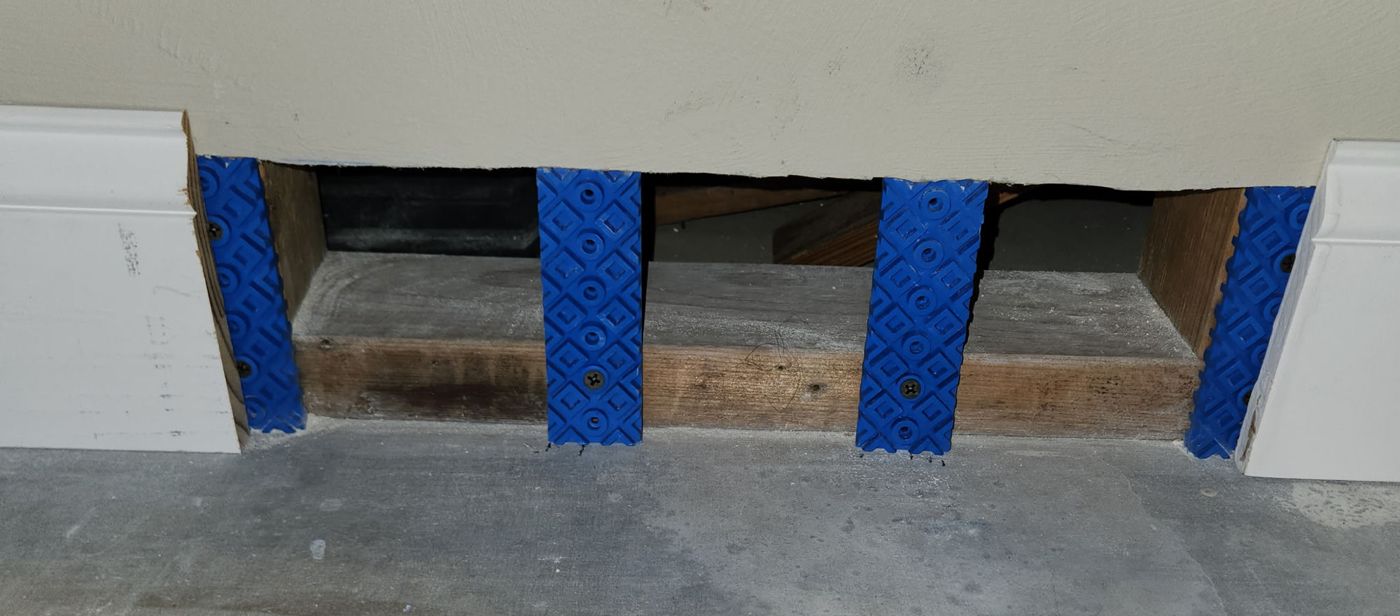
Rock Bloks is a patent-pending drywall drainage and ventilation system. The bloks mount at the base of each stud and hold the drywall up off the base plate, leaving a continuous gap along the bottom of the wall behind the baseboard. Water that runs down inside a wall — from a ceiling leak, a burst line, or a flood — drains back out at the floor instead of sitting in the cavity, and air flows up into the bay so it dries.
Wall below a ceiling leak
- ✕ Water runs down inside the bay
- ✕ Collects at the sealed base plate
- ✕ No drainage, no airflow
- ✕ Found months later as staining and rot
Same wall with Rock Bloks
- ✓ Water runs down and out at the base
- ✓ Continuous gap along the base plate
- ✓ Air flows up into the bay
- ✓ The cavity dries with the room
Worried about the walls under that leak?
Tell us about your home or project. The founder will personally reach out — how Rock Bloks installs, how many you would need, and whether it fits.
Get more information →Sources
- IICRC S500 Standard for Professional Water Damage Restoration — iicrc.org/s500
- U.S. EPA, Mold Course (Chapter 4) — epa.gov/mold
- FEMA, Dealing with Mold & Mildew in Your Flood-Damaged Home — fema.gov
Common questions
Should I poke a hole in a bulging ceiling?+
Yes — from the side, not from underneath, with a bucket ready. A bulge is a pocket of water pushing down on the sheet. A small controlled drain hole is much safer than letting the section fail on its own.
Can a wet ceiling be saved?+
Sometimes. Clean water, caught within 24–48 hours, no sagging, and verified dry with a meter — that ceiling can often stay. Any sag, softness, crumbling, or floodwater means it comes out.
How long does a wet ceiling take to dry?+
The drywall itself typically dries in 3–5 days with airflow and dehumidification. Wet insulation above it takes far longer and usually should be removed instead of dried.
Do I need to check the walls after a ceiling leak?+
Yes. Water travels along framing and down into wall cavities, so the ceiling stain is the low point, not the whole story. Take readings low on nearby walls and pull a baseboard where you suspect it.
What if the ceiling is textured and the house is old?+
Stop and get it tested before disturbing it. Textured and popcorn ceilings in older homes can contain asbestos, and sanding, scraping, or breaking them up is exactly what you must not do.