The short answer
If floodwater got into your walls, the drywall and insulation below the waterline are coming out — floodwater is Category 3 under the restoration standard, so porous material is removed rather than dried. Get the wall open, get the cavity dry, and verify it with a meter before you close it up. And when you rebuild, change one detail: give the base of the wall a way to drain and breathe, so the next flood is a cleanup instead of a gut.
damaged in Kerr County in the July 2026 flooding
destroyed or heavily damaged by the fast-moving water
the window before mold begins in wet material
Where things stand
Repeated rounds of heavy rain in mid-July 2026 pushed the Guadalupe River out of its banks again, damaging neighborhoods across Kerr County just a year after the catastrophic 2025 flooding. State damage assessments put roughly 490 homes and about 100 businesses damaged in Kerr County, with 135 homes destroyed or heavily damaged by the fast-moving water, and most of the affected properties owner-occupied single-family homes facing a long repair and rebuilding road.
If you are in that group, this page is about one specific piece of it: the walls.
Before anything else
Register for federal assistance at disasterassistance.gov and document everything — photos and video of every room and every wall before you remove anything, plus a written inventory. Insurance and assistance both run on documentation, and once the drywall is in a dumpster the evidence is gone.
Floodwater changes the rules
Under the restoration standard (IICRC S500), floodwater and ground surface water are Category 3 — the most contaminated class. River flooding carries sewage, fuel, agricultural runoff, and whatever else it picked up on the way. That means porous materials that absorbed it come out rather than getting dried: drywall below the waterline, fiberglass and cellulose insulation, carpet and pad, particleboard.
This is not a case where drying it out fast enough saves it. Speed matters for the framing and the structure, not for the drywall.
The wall sequence
- Document first. Photos, video, and an inventory before demolition.
- Protect yourself. N95 respirator, gloves, eye protection, boots. Category 3 water plus disturbed drywall is not a t-shirt job.
- Flood cut above the waterline. Cut a horizontal line at 2 or 4 feet — above the highest water mark — and remove the drywall below it. Those heights match standard sheet dimensions for the rebuild.
- Pull the insulation. Wet fiberglass and cellulose hold water against the studs and block airflow. It all comes out.
- Clean the framing. Detergent and water on studs, base plate, and sheathing, then thorough drying. The EPA does not recommend routine bleach for mold cleanup.
- Dry and verify. Air movers plus dehumidification until a moisture meter confirms it — not until it looks dry. Central Texas humidity in August will fight you on this.
- Then rebuild. And this is the decision point.
Document, extract standing water, get air moving. Mold clock is running.
Flood cut, remove insulation, clean framing, run drying equipment continuously.
The one chance to change the wall detail so this does not repeat.
Why the same walls flood the same way twice
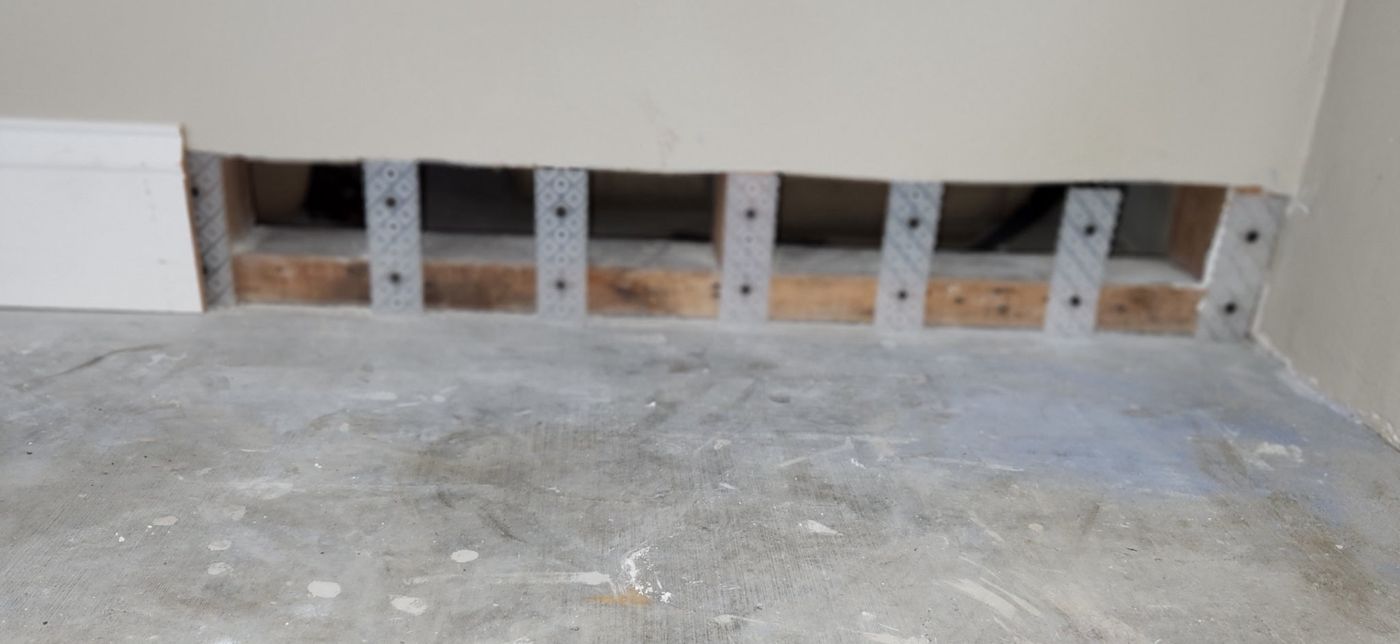
A standard wall runs the drywall down flush against the base plate, and the baseboard seals over that joint. The cavity is a closed box at the bottom. When water gets in, it collects there — no drainage, no airflow — which is exactly why the flood cut is necessary in the first place. Cutting the wall open is how you manufacture the drainage and ventilation the wall never had.
If you rebuild it exactly the way it was, you have rebuilt that same closed box. In a river valley that has now flooded in consecutive years, that is worth thinking about while the walls are already open.
Rebuilt the same way
- ✕ Cavity sealed at the base plate again
- ✕ Next flood pools in the same place
- ✕ Full flood cut and gut, again
- ✕ Same bill next time
Rebuilt with Rock Bloks
- ✓ Continuous drain and vent gap at the base
- ✓ Water drains back out onto the floor
- ✓ Air flows up into the bay to dry it
- ✓ Cleanup instead of demolition
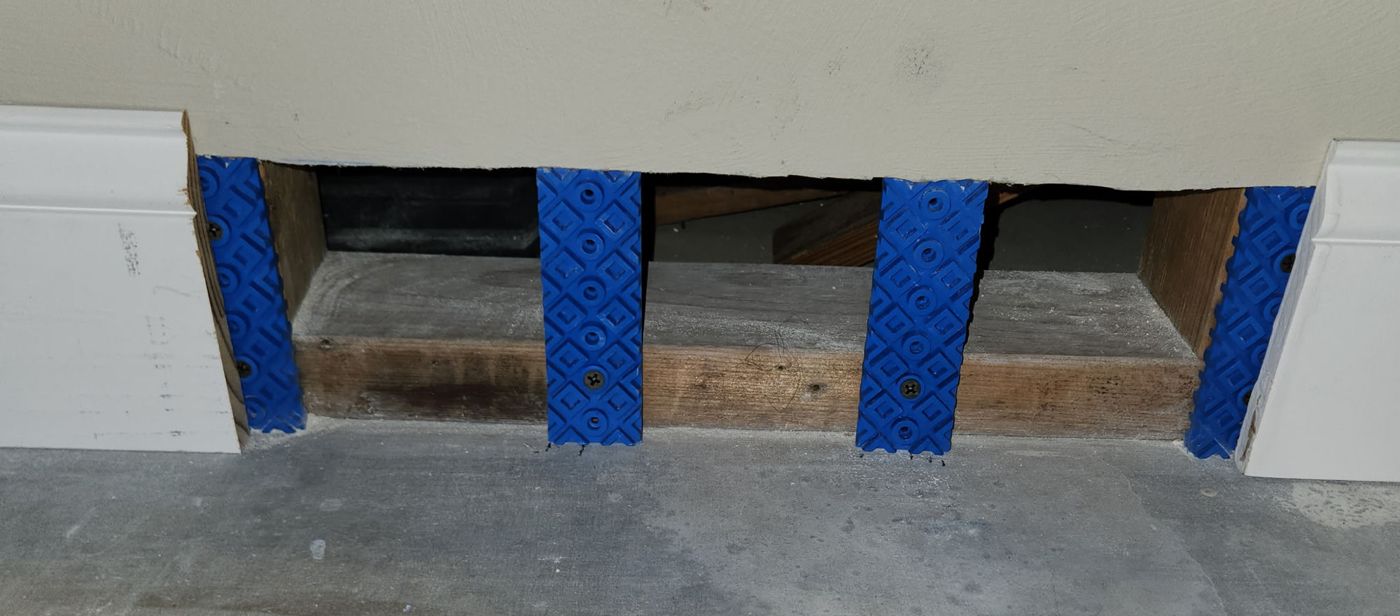
Rock Bloks is a patent-pending drywall drainage and ventilation system, invented by a Florida homeowner who flooded three times. Rigid perforated bloks mount at the base of each stud and hold the drywall off the base plate, leaving a continuous gap along the bottom of the wall, hidden behind the baseboard. Same studs, same base plate, standard framing. Made in the USA and available nationwide — including Texas.
Rebuilding in the Hill Country?
Tell us about your home. The founder will personally reach out — how Rock Bloks installs during a rebuild, how many you would need, and whether it fits.
Get more information →Sources
- The Texas Tribune, Texas flood destroyed 135 Kerr County homes (July 2026) — texastribune.org
- KUT, Almost 500 homes and 100 businesses damaged in Kerr County floods — kut.org
- IICRC S500 Standard for Professional Water Damage Restoration — iicrc.org/s500
- U.S. EPA, Mold Course (Chapter 4) — epa.gov/mold
- FEMA, Disaster Assistance — disasterassistance.gov
- FEMA, Dealing with Mold & Mildew in Your Flood-Damaged Home — fema.gov
Common questions
Can I save drywall that got flooded by the Guadalupe?+
No. River floodwater is Category 3 under the restoration standard — contaminated — so porous materials that absorbed it are removed rather than dried, regardless of how quickly you got to them.
How high do I cut the drywall?+
Above the highest waterline, commonly at 2 feet or 4 feet since those match standard sheet dimensions. Water wicks up the paper facing well above the visible line, so cut higher than the stain.
How long should the framing dry before I close the wall?+
Until a moisture meter says so, not a calendar. Compare readings to framing in a part of the house that never got wet, and expect August humidity to slow it down.
Where do I get help in Kerr County?+
Start at disasterassistance.gov to register for federal assistance, and check Kerr County and City of Kerrville emergency management channels for local debris removal, permitting, and rebuild guidance.
What should I change when I rebuild?+
The base of the wall. Giving the cavity a permanent way to drain water out and let air in is the difference between a future cleanup and a future gut — see what a drywall ventilation system is.